


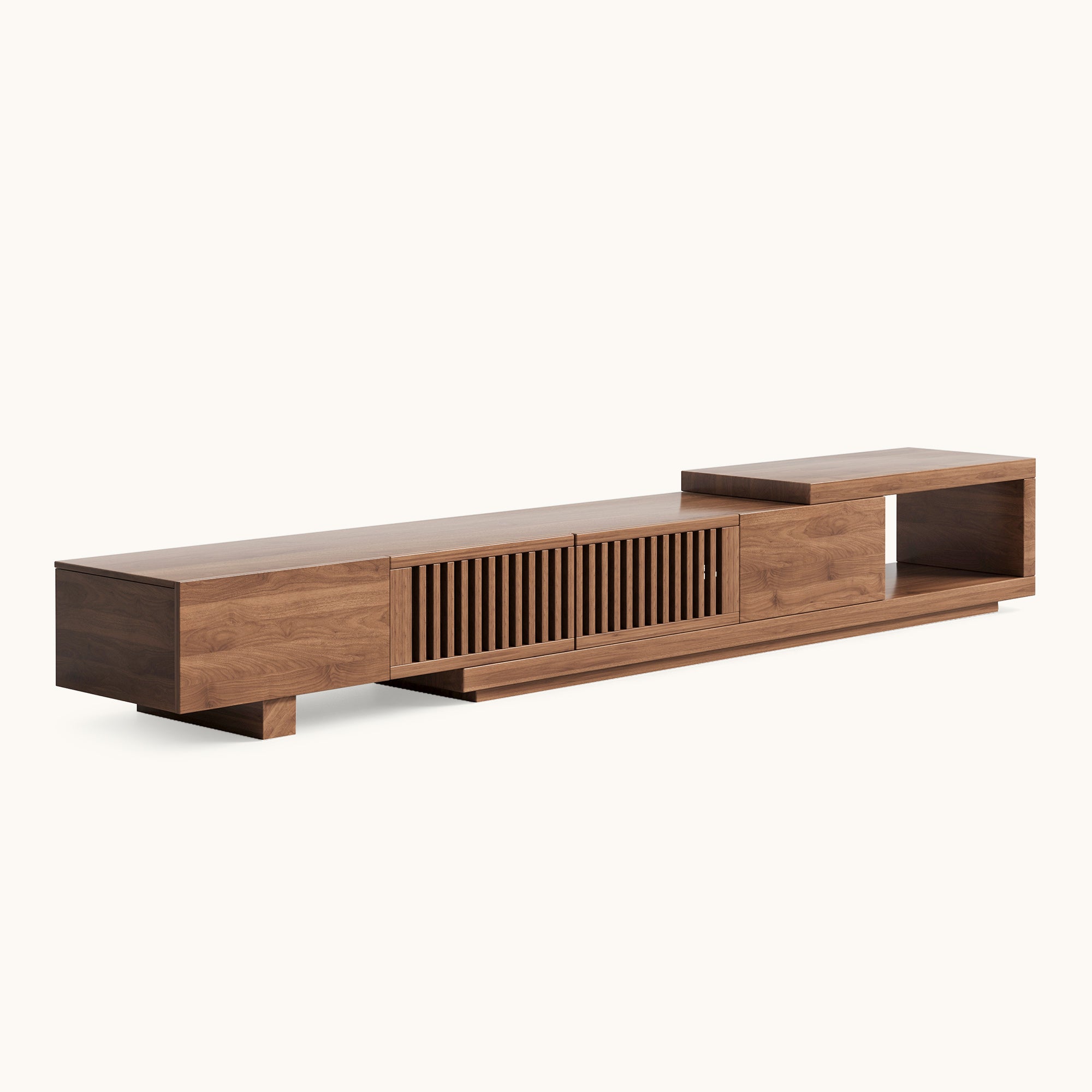


A mid century modern tv stand works or fails on three quiet decisions: the material it is made from, whether its width respects the screen above it, and how its interior absorbs the black boxes and cables that daily life insists on. The silhouette gets the attention, but walnut veneer versus solid timber, console width versus TV width, and open shelf versus closed cabinet are what determine whether the piece still feels intentional five years from now. This guide works through those three layers in order, with a comparison table you can measure against your own wall and viewing distance.
Materials: What “Walnut Finish” Actually Means for Daily Life
Mid-century furniture is inseparable from warm timber tones, and walnut, teak and oak are the three names that come up most often. Walnut brings a deeper, chocolate-toned grain with more dramatic figure, which makes it a natural grounding element in rooms with pale walls or light floors. Teak carries a golden-brown warmth and is the timber most closely tied to the period’s Scandinavian and British roots, while oak in a light or mid finish reads slightly more Scandinavian and airy. If the room receives limited daylight, a lighter teak or oak tone keeps the piece from feeling heavy; in a bright room, walnut adds depth and contrast.
The more practical question is construction. “Walnut finish” can mean a thin laminate, a wood veneer over engineered board, or solid timber, and none of those labels automatically tells you how the piece will behave across a wide span. A high-quality veneer over a stable engineered core can actually be more dimensionally stable than solid wood, which expands and contracts with seasonal humidity. Solid wood, on the other hand, can be sanded and refinished if a corner takes a hit during a move. For a TV console holding a soundbar, a streaming box and possibly a game console, the sensible middle ground is a reinforced engineered-wood carcass with a genuine wood veneer and solid wood legs or a metal base.
Fluted and slatted fronts deserve a separate note because they are everywhere in retro-inspired consoles right now. A continuous vertical slat pattern adds architectural texture that shifts with the light across the day, and it lets infrared remote signals pass through to the devices behind. If the slats are purely decorative and the doors are solid, you will be opening a cabinet every time you reach for a remote—a small friction point that compounds over years. The better fluted pieces pair the texture with push-to-open or sliding mechanisms, so the visual rhythm stays intact without turning daily use into a chore.
The Size Decision: Start with the Screen, Then the Wall
The most common mistake is choosing a console that matches the TV’s width rather than supporting it. A 65-inch screen measures roughly 57 inches across the picture itself, so a console rated “for TVs up to 65 inches” at 59 inches wide leaves barely an inch per side—the rating tells you the top can hold the TV, not that the proportions will look right. The working rule is to look for a console at least a few inches wider than the screen on each side. For a 65-inch TV, the practical range is 60 to 72 inches of console width, with 66 to 72 inches reading best because the stand frames the screen the way a mat frames a print.
Depth is the second measurement people forget. A shallow retro TV stand at 12 to 14 inches will hold a streaming stick and a remote, but a modern AV receiver or a soundbar with a subwoofer needs closer to 16 to 20 inches of usable interior depth. Ventilation matters too: devices need breathing room behind them, and closed cabinets without rear cutouts turn into heat traps. A depth of 16 to 18 inches with a ventilated or removable back panel is a safer baseline for anything beyond a basic streaming setup, and it also gives the TV’s feet a full footprint rather than leaving them perched near the edge.
Height ties the whole proportion together. Mid-century consoles typically sit low, and 18 to 24 inches is the comfortable range for most living rooms because it puts the center of a 65-inch screen close to seated eye level, roughly 40 inches off the floor. A taller piece closer to 26 to 28 inches can work beautifully as a dual-purpose media console and sideboard in an open-plan dining area, but it raises the sightline and suits wall-mounted screens or rooms where the TV is not the sole focal point.
Size, Storage and Layout: A Comparison Table
The table below is the fastest way to match a room’s proportions to a storage layout. Width ranges are console width, not TV width, because the console is the piece you are actually buying.
| Console width range | Best for TV size | Typical height | Storage layout that works | Trade-off to know |
|---|---|---|---|---|
| 48–54 inches | 32–43 inch screens | 17–22 inches | Two side cabinets plus a central open shelf; shallow drawers for remotes and cables | Limited depth for large AV receivers; best for bedrooms, apartments and secondary rooms |
| 60–66 inches | 50–55 inch screens | 18–24 inches | Three-zone layout: flanking cabinets, central adjustable shelf, open cubby for a soundbar | The most versatile apartment range, but open shelving can expose cable clutter if not managed |
| 70–80 inches | 65–75 inch screens | 18–24 inches | Wide partitioned storage: tall side cabinets for consoles, low center shelves for media players, sometimes drawers for small items | Needs a wall long enough to let the piece breathe; in a narrow room it can dominate |
| 78–90 inches | 75–85 inch screens, or media-room builds | 18–26 inches | Five or more storage zones: open shelving for remote access, hidden side cabinets, adjustable interior shelves | The piece becomes architectural; measure the walking path before committing |
| Extendable, 78–103 inches | 75–100+ inch screens, or changing layouts | 17–22 inches | Storage zones that reconfigure with the width; sliding or retractable sections | Mechanism adds a small premium; measure the retracted depth against a tight wall |
The 78-inch-and-above category is where proportion becomes architectural. A console at 86–88 inches wide visually anchors a large wall and prevents the “floating screen” look that smaller units create under massive televisions. If the room may change—a move, a future larger screen, a shift from a closed cabinet to open shelving—an extendable design removes the pressure to predict the next five years perfectly. The piece adjusts with the room rather than forcing the room to adjust to it.
Layout Inside the Console: Open, Closed and the 80/20 Rule
Storage layout is not just about capacity; it is about which devices deserve to be seen and which should disappear. A useful principle for retro media furniture is the 80/20 rule: keep roughly 80 percent of the console’s interior closed and only 20 percent open. The closed sections swallow the router, the surge protector, the game console and the tangle of power bricks. The open section—usually a central shelf—holds the one or two pieces that benefit from line of sight or daily access, such as a soundbar or a media player. Designers of mid-century consoles often build in exactly this combination: expansive open shelving for remote access, hidden side cabinets for a clutter-free look, and integrated cable management to disappear unsightly cords.
This is where drawer configuration matters more than door count. A console with three shallow drawers plus a slatted double-door cabinet solves a specific daily problem: remotes, coasters, charging cables and controller accessories live in the drawers, while larger black boxes sit behind the doors. Nothing gets buried in the back of a deep shelf, and soft-close slides mean the drawers do not announce themselves every time someone reaches for a controller after the room has gone quiet.
Cable management should be designed in, not added later. Pre-drilled rear cutouts aligned with the central compartments let power and HDMI cables drop directly to the wall without draping across the floor. If the back panel is solid, a two-inch hole in the lower section handles cable routing, and a second opening higher up can provide passive heat exhaust. The goal is not to hide every wire perfectly on day one—it is to make it easy to add or swap a device without dismantling the entire setup.
For rooms that need the console to do double duty, layout flexibility is the deciding feature. A piece with adjustable shelves can shift from soundbar height to receiver height in a few minutes. A taller 26-inch console with four doors can migrate from the living room to a dining area as a credenza, holding dinnerware instead of media boxes. That kind of adaptability is what separates a piece that survives a redesign from one that gets replaced alongside the sofa.
Matching the Console to the Room’s Existing Lines
A mid-century TV console rarely lives alone. It sits under a wall-mounted screen, beside a sofa with tapered legs, across from a coffee table with a similar low profile. The console’s leg style is the fastest visual bridge: splayed or tapered wood legs lift the box off the floor and let light run underneath, which keeps a small room from feeling grounded and heavy. A recessed plinth base creates a similar floating effect but reads more contemporary and slightly more formal. Neither is wrong; the question is whether the rest of the room already uses visible legs or solid bases.
Material repetition ties the composition together without matching suites. If the room has walnut picture frames or a teak side table, a walnut-toned console continues that thread. If the palette is lighter—oak floors, cream walls, linen seating—a darker walnut console can act as the grounding element, while an oak or lighter veneer keeps the room airy. The fluted or slatted front adds a third texture without introducing a new color, which is why it layers so easily over rugs, ceramics and plants.
One practical styling note: leave a little breathing room on the top surface. A console that is completely covered in decor loses the horizontal calm that makes the style work. A trailing plant on one side, a short stack of books or a ceramic vessel on the other, and a clear zone around the screen is usually enough. The console is the anchor, not the gallery.
Choosing with the Whole Room in Mind
The right mid-century media console is the one whose width makes the screen look settled, whose materials make the room feel warmer, and whose interior layout quietly absorbs the technology without turning daily use into a negotiation. Start with the screen’s width plus a comfortable margin, confirm that the interior depth fits the deepest device, and choose a storage mix that keeps most of the clutter behind doors.
For a 65-to-75-inch screen, a fluted-front console with adjustable shelves and push-to-open doors keeps the texture while hiding devices behind slats that still pass a remote signal. A walnut-finish console with a drawer-and-slat layout suits mixed everyday clutter, because the drawers take remotes and cables while the slatted doors cover the larger boxes. An extendable slatted design is the safer choice when the room’s proportions may change, since it starts at a standard width and widens only when the wall allows. A deep-fluted walnut console adds architectural rhythm without visual noise, and a geometric wide console with three storage compartments anchors a long wall under a very large screen. For a softer fluted profile, this walnut fluted media cabinet works well in apartments where the console is seen from the side as often as the front. Browse the full mid-century modern TV stand collection to compare widths and storage configurations side by side.
Frequently Asked Questions
How wide should a TV stand be for a 65-inch TV?
Aim for 60 to 72 inches of console width. Around 66 to 72 inches frames the screen most naturally and leaves room for a lamp or speaker at one end without crowding the picture. A stand narrower than the TV may hold the screen, but the proportions will read top-heavy.
Is walnut veneer as durable as solid walnut?
A quality walnut veneer over a stable engineered core can be very durable and more dimensionally stable across a wide span than solid wood. Durability depends more on panel thickness, support spacing and joinery than on the “veneer” label alone. Solid wood has the advantage of being sandable and refinishable if damaged.
Do fluted or slatted TV stand doors block remote signals?
Slatted or fluted fronts with open gaps generally allow infrared signals to pass through, so a remote can control a device behind the door. Purely decorative fluting over a solid door will block the signal and require opening the cabinet.
What is the best storage layout for a media console with a game console?
Look for at least one taller side cabinet or an adjustable shelf that can be raised to fit the console upright, plus a ventilated back or rear cutout for heat exhaust. Keep the game console in a section with airflow rather than a sealed drawer, and use the closed side cabinets for the router and power bricks.
Can a mid-century TV stand work in a small apartment?
Yes, provided the width is proportional to the wall and the depth does not swallow the walking path. A 48 to 60 inch console with closed storage and tapered legs keeps the floor visible beneath the piece, and an extendable model can start narrow and widen only when the layout allows.

